Krishnamurti on freedom: no guru, no method and no conflict
Jiddu Krishnamurti, groomed to be a world teacher, spent his life rejecting gurus and methods; he held that only direct observation dissolves problems.
· 3 min read · Sources

In 1 minute
- Krishnamurti, named in his youth as World Teacher by the Theosophists, spent his life refusing the role of master.
- He says almost no one truly wants freedom, and rejects spiritual authority and every method, because techniques only repeat conditioning.
- According to him, a religious life is a life without problems, not because they never arose, but because they were understood the moment they appeared.
Full article
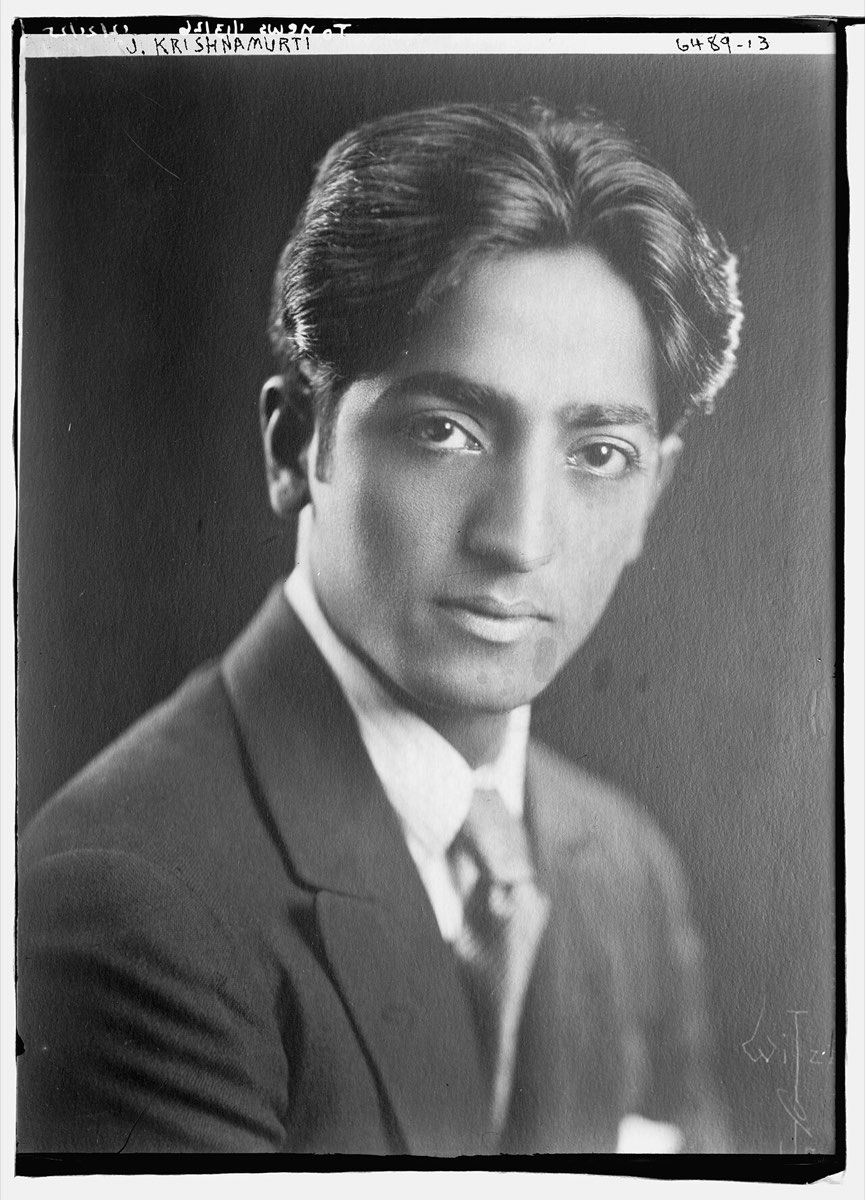
At age 13, an Indian boy was named the "World Teacher" the Theosophists had been expecting. An order was created in his name, donations poured in, and he was groomed for the role. Decades later, Jiddu Krishnamurti (1895-1986) spent his life refusing exactly that position. In lectures to audiences around the world, he said he had no doctrine to sell, no disciples, and no method.
That trajectory helps make sense of what he says in one of his talks on inner freedom. The central argument is that no one frees anyone else: not a guru, not an organization, not a meditation technique. What he proposes is an inquiry of one's own, carried out the instant a problem appears, one that requires giving up authority, memory and effort.
From World Teacher to critic of gurus
Krishnamurti was born in Madanapalle, India, in 1895. In 1909, his father became an employee of the Theosophical Society, in Adyar, and the boy was "discovered" by the Theosophist Charles Leadbeater, who saw him as the World Teacher the movement had been awaiting. In 1911 the Order of the Star in the East was founded, with him at its head. The death of his brother Nitya, in 1925, marked the beginning of his break from his mentors. His later texts and lectures are tied to no religion, nor to East or West.
It is against that background that his refusal of authority makes sense. Someone groomed to be a master to multitudes chose to dismantle the classic relationship between teacher and disciple.
Almost no one wants to be free
Krishnamurti starts from an uncomfortable observation: most people prefer comfort, emotional security and social stability. But without total freedom, not just outward but psychological, one cannot discover what is true. A mind bound by fears, desires and beliefs leaves no room for the new. For him, freedom is therefore not a philosophical luxury, but an urgency.
No authority
The relationship between teacher and disciple, in his view, creates dependency and destroys the capacity to see for oneself. Krishnamurti said he was not there to teach, but to learn alongside the audience.
Learning, in this sense, is not accumulating knowledge. It is observing as it happens, with fresh attention and without judgment. That, he said, would only be possible for a mind free of authority, including the authority of its own memory.
How conflict is born
Psychological problems arise, for him, when the mind contradicts itself, as when desire opposes fear, or ambition opposes ethics. Desire itself would not be the problem. The conflict would come from the multiplicity of desired objects and from the continuity thought gives to desire, keeping it alive through memory.
Here enters what he calls psychological time: the mind lives between a past made of memory and experience, and a future made of projections and expectations. Full living would happen outside that line, in a present where there is no room for conflict.
The false problem of "how"
Whoever hears this tends to ask how to do it. Krishnamurti rejects every method, since any technique presupposes repetition and reinforces conditioning. Real transformation, he says, follows no recipe: it is born of immediate perception, without effort and without any desire for a result.
The position carries a paradox, one critics of his thought often point out: a teaching that rejects method still ends up, in some way, teaching one. Krishnamurti would answer that observation is not a method, but a direct act.
Isolation and the religious mind
He separates isolation, which would be self-centeredness, from solitude, which he calls total inner freedom. Only a mind entirely alone, free of the influence of traditions, dogmas and desires, could discover the sacred and the timeless. That mind would be silent and empty, and only it would know beauty, which for him is not a matter of aesthetics, but an expression of the true.
A truly religious life, he states, is a life without problems. The challenges do not disappear: each one is understood the instant it arises, without being carried forward in time, repressed or denied. For him, conflict deteriorates the mind, and where there is deterioration there is no clarity, no love and no intelligence.
What remains
The lecture ends with no guru, book, church or method on offer. Only each person can discover themselves, and that depends on freedom from traditions, systems, beliefs and fears. In short, living would be a process of learning about oneself, made of attentive observation, without judgment, without accumulation and without escape.
Sources and references for this article
Lecture by Jiddu Krishnamurti on inner freedom
Jiddu Krishnamurti, Wikipedia (biography, Theosophical Society and Order of the Star in the East)Translated from Portuguese. This article was rewritten from a post on the original blog, in Portuguese. Read the original
Get the best articles of the week
One email a week, no spam. Unsubscribe anytime.
Read next
 The EastThe Book of Mirdad: Mikhail Naimy's parable on the self, silence, and the word
 The East · VideoŚūnyatā: what Nagarjuna meant by emptiness, and what it is not
 Vedanta and YogaVedānta: texts, schools, and the study method of one of India's six philosophies
 Vedanta and Yoga · VideoSahaja avasthā, the natural state of Being: the image of the rope and the snake in Vedānta
 Vedanta and Yoga · VideoUpa-paramā: Vedānta's renunciation means leaning on nothing, not giving up everything