Is the universe real? Advaita Vedānta's three answers, from creation to "never born"
Advaita Vedānta offers three ways to understand the world, from ordinary creation to ajāta vāda, for which nothing ever arose; all three point to Brahman.
· 3 min read · Sources

In 1 minute
- In a talk, Swami Sarvapriyananda lays out three views of the world within Advaita Vedānta, and all of them point to the same end: everything is Brahman, infinite consciousness.
- In the first, the world is created and then lived in; in the second, it arises together with experience, as in a dream; in the third, associated with Gauḍapāda, nothing was ever created at all.
- The theories are pedagogical tools for people at different stages of the path, not dogmas.
Full article
Is the world real, or does it only seem to be? And what if the answer isn't either, but a ladder of answers, one for each rung the student stands on? That's the proposal of a talk by the monk Swami Sarvapriyananda, a teacher of Advaita Vedānta, who draws on the Yoga Vāsiṣṭha and a digest of it, the Nectar of Supreme Knowledge, to lay out three ways of understanding the world within the non-dual tradition.
The Yoga Vāsiṣṭha is a hugely influential philosophical text in Hinduism, traditionally attributed to the sage Vālmīki but of unknown authorship, dated by scholars between the tenth and fourteenth centuries. Advaita Vedānta, the school of non-duality, teaches that only Brahman, infinite consciousness, exists, and that multiplicity is appearance. The three theories that follow don't compete with each other. Each, according to the swami, starts from a different point and arrives at the same place.
Creation first, then experience
The most common theory is called sṛṣṭi-dṛṣṭi vāda, "creation first, seeing after." It appears in the Upaniṣads, in the Gītā, and in the commentaries of Śaṅkara, the school's great commentator. In it, the world was created beforehand, by God or by an event like the Big Bang, and people are born into it. It's held to be real right up until the moment Brahman is realized, and it serves as the foundation for the beginner, for whom the world is a platform for self-knowledge.
Seeing is creating
The second, dṛṣṭi-sṛṣṭi vāda, is the talk's main focus. The world doesn't exist before being perceived: it arises together with experience, as in a dream, where seeing is existing. Everything one sees appears in consciousness, like images in the mind of someone dreaming, and would be a transient mental creation. The swami points to this one for the more mature meditation practitioner, who already sees the world as a reflection of their own consciousness.
Nothing was ever created
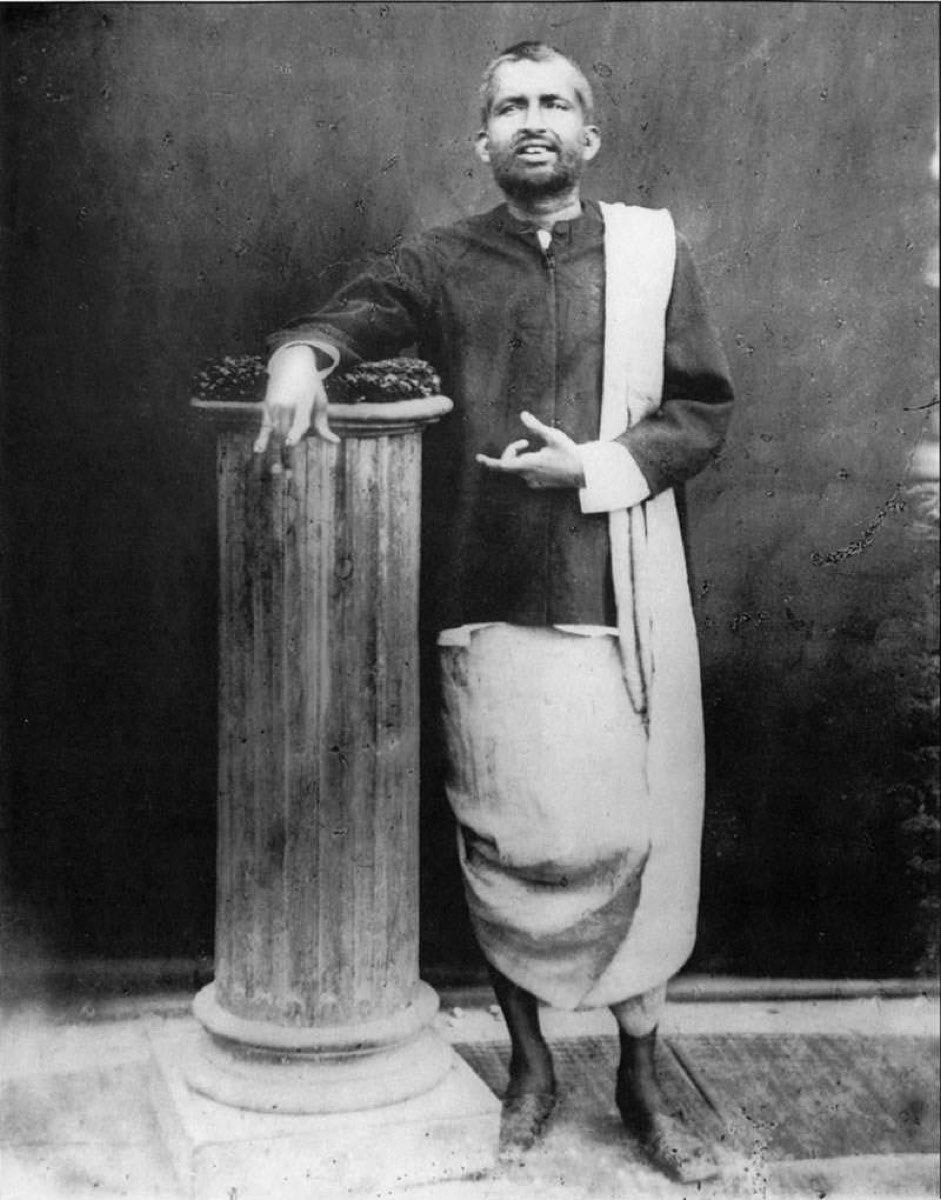
The third, ajāta vāda, is the most radical. It was taught by Gauḍapāda, a teacher who predates Śaṅkara, and was held, the swami says, by figures such as Ramakrishna. It claims creation never happened: birth and death would be illusions, and only Brahman would exist. Gauḍapāda, author or compiler of the Māṇḍūkya Kārikā, is regarded as the "teacher's teacher" of Śaṅkara, and scholars place his life between the sixth and seventh centuries. It's the view of the advanced seeker, for whom truth is unshakable.
Three images
The swami turns to analogies. In a dream, everything seems real until the person wakes up, and the world would be something similar. Whoever looks for Brahman outside the world is like someone who throws away a necklace to search for "pure gold" elsewhere, since gold and ornament are the same thing. And the world would be the sparkle of consciousness: everything that appears is Brahman in the form of phenomena.
The theories, he emphasizes, aren't dogmas, but pedagogical tools. They exist to lead the seeker from appearance to reality, not to settle which one is the true one. Whoever is still attached to the world starts by taking it as real. Whoever perceives that everything is mental phenomena practices detachment. Whoever senses that only Brahman remains rests in silence.
Objections
The talk takes on three common objections. Everyone sees the same world, which would prove it's real. The world persists day after day, unlike dreams. And Brahman could just be another concept of the mind. The swami and the philosopher G. R. Malkani answer that even dreams hold internal coherence while they last, that the shared world is a collective appearance sustained by cosmic mind, and that Brahman is the pure consciousness that makes every dream, idea, and experience possible. These are philosophical answers, not empirical demonstrations.
An exercise
The talk ends with a practice from Atmananda Krishna Menon's Direct Path. One looks at an object and notices that what appears are colors and shapes, not an "external object." Next, one recognizes that this arises in consciousness, and widens the perception to the idea that the entire world happens within oneself. For the swami, that's the beginning of non-dual awakening, the recognition that there are not two, neither inside nor outside, and that there is only Brahman.
Sources and references for this article
Talk by Swami Sarvapriyananda on the three views of reality in Advaita Vedānta
Yoga Vāsiṣṭha and its digest, Nectar of Supreme Knowledge
Gaudapada, Wikipedia (English)Yoga Vasistha, Wikipedia (English)Advaita Vedanta, WikipediaTranslated from Portuguese. This article was rewritten from a post on the original blog, in Portuguese. Read the original
Get the best articles of the week
One email a week, no spam. Unsubscribe anytime.
Read next
 Vedanta and YogaGita, lesson 21: what is nonexistent, what is false, what is real
 Vedanta and Yoga · VideoDoes God sleep? What Advaita Vedānta says about the consciousness that never sleeps
 Science and consciousnessVedānta and quantum physics: what the observer has to do with reality
 Western esotericism · VideoThe All is Mind: the universe as a mental creation, according to Hermeticism
 Vedanta and Yoga · VideoUpa-paramā: Vedānta's renunciation means leaning on nothing, not giving up everything