What Dies When Someone Dies? The Answer from Ramana Maharshi and Advaita Vedanta
For Ramana Maharshi, the body dies and the Self does not; the method for recognizing it is asking “Who am I?,” a teaching of the Vedanta tradition, not a scientific finding.
· 3 min read · Sources

In 1 minute
- Ramana Maharshi (1879-1950), an Indian master of Advaita Vedanta, taught that death is a fact of the body and that the Self, the witnessing consciousness, is never born and never dies.
- His central method is self-inquiry (Atma Vichara): asking “Who am I?” until the ego dissolves, since the fear of death is said to arise from identifying with the body.
- The video behind this piece claims neuroscience confirms the peace of those who let go, without citing any studies; the central idea is spiritual philosophy, not science.
Full article
Which part of a person actually dies when they die? That is the question opening a video from the channel Insightes on death, built on the teachings of Ramana Maharshi, one of the best-known Indian masters of self-knowledge.
The answer it offers belongs to Advaita Vedanta, the strand of Indian thought that holds the self and ultimate reality to be one. This is not a scientific finding but a spiritual philosophy offered as an answer to the fear of dying. This piece traces the master's life, the method he taught, and what the tradition says about time, reincarnation, and fear.
Who Ramana was
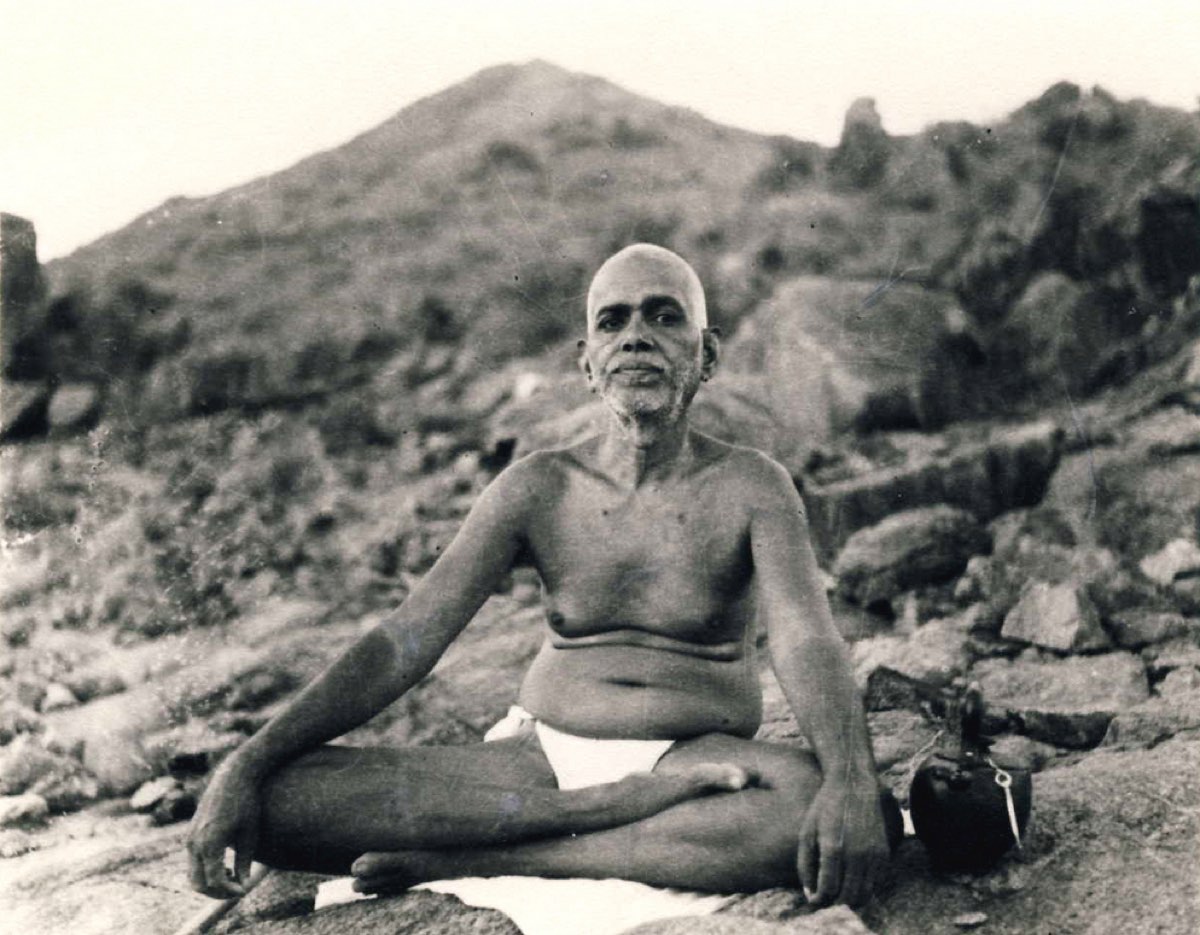
Ramana was born in Tiruchuli, in Tamil Nadu, on December 30, 1879, and died on April 14, 1950, in Tiruvannamalai. In 1896, at age 16, he underwent what the tradition describes as a “death experience”: on the verge of dying, he became aware of a force he recognized as his true self, with no guru and no formal instruction.
He left ordinary life behind and settled at the foot of the hill of Arunachala, in southern India, which he regarded as Shiva himself in physical form. He did not seek disciples, yet drew people from around the world. The video says he influenced Mooji, Papaji, and Eckhart Tolle.
The body dies, the Self does not
The thesis is that death is a fact of the body, and the error lies in believing we are the body. Out of that confusion, fear and a desperate search for permanence are said to arise. There is, however, something that is never born and never changes: the Self, or the true I, the silent witness that observes thoughts, emotions, and aging without being altered by them.
The video offers an image: the Self is like the space inside a vessel, unaffected when the vessel breaks. Another compares the body to a candle that goes out and the Self to the wind that never stops.
The question “Who am I?”
Ramana's method is self-inquiry, in Sanskrit Atma Vichara, which he recommended as the chief path for removing ignorance, alongside devotion and surrender. Instead of seeking answers outside, the practitioner asks who thinks, who feels, who says “my body.” The question should not be answered with sentences: the point is to return to the place from which thought arises, until only formless awareness remains.
The goal, the video says, is not to build new beliefs, but to strip away everything that is not the Self: ideas, roles, emotions. Who Am I? is also the title of one of the main works attributed to him.
Time, reincarnation, and fear
For Ramana, according to the video, time is a production of the mind: the past is memory, the future is projection, and only the present moment exists. The text claims Einstein converged on this idea, but gives no indication of where or how, leaving the comparison unsupported.
As for reincarnation, the cycle of births and deaths called samsara is said to continue as long as there is identification with the body and the sense of being a separate someone. When that illusion dissolves, moksha, liberation, follows. Ramana is said to have put it this way: “Dying before dying is freedom.”
The fear of death, the video says, is a flight from a mirror. Death would act as a teacher, reminding us that time is limited and that one should live with presence.
An unsupported claim
Near the end, the text asserts that neuroscience shows the fear of dying is linked to the prefrontal cortex and to the ego's narrative, and that deep meditation reduces that activity. No research is cited, and the claim should not be read as a proven result. It stands as the opinion of whoever produced the video.
The piece closes by returning to the image of a presence that nothing can threaten: what a person truly is, it holds, was never at risk.
Sources and references for this article
Video from the channel Insightes on death and the Self, according to Ramana Maharshi
Ramana Maharshi, Wikipedia (biography, dates, and self-inquiry)Official site of Ramana Maharshi's teaching (Sri Ramanasramam)Translated from Portuguese. This article was rewritten from a post on the original blog, in Portuguese. Read the original
Get the best articles of the week
One email a week, no spam. Unsubscribe anytime.
Read next
 Vedanta and YogaGita, lesson 15: knowing isn't doing, and the knower is the Self itself
 Vedanta and YogaConsciousness with a body: what Vedānta says the “self” is
 Science and consciousnessVedānta and quantum physics: what the observer has to do with reality
 The EastThe Book of Mirdad: Mikhail Naimy's parable on the self, silence, and the word
 Vedanta and Yoga · VideoWhat is consciousness? Vedanta faces off with neuroscience, physics, and AI